SIS AUDIO LIBRARY

The SIS Audio Library allows you to hear recent speakers and professors, providing insight into current and relevant political and social issues of our time. Their expert instruction and a variety of guest speakers are just a click away at: http://www.american.edu/sis/pouch/sisaudio.html

Friday, April 20, 2007

We’re all just ‘Tree-huggers’


Reflections from a Global Videoconference on Climate Change and Oil Dependence at the World Bank

In this office we get into some heated debates. Sometimes they center on our ideals for the justices of tipping our waiters, but oftentimes they extend well beyond our daily lives to the bigger questions in life—how do we solve any of these global problems?

We are always educating and informing one another about our various backgrounds and expertise, enlightening again and again from the various facets of our knowledge. I, personally, am always talking about trees. Andy, Jeremy, and Josh tend to focus on nuclear war. Kathleen is in the Middle East, whereas Gabe and Fred are posing China and Asia’s viewpoint to our questions. We seem separated by our disciplines, but from attending a World Bank Conference today, I am reminded that our focuses are much more intertwined than at first glance and maybe…we are all tree-huggers after all.

I had the privilege, an invitation often offered to AU students, to attend a World Bank global videoconference related to climate change and oil dependence. The conference was sponsored by Americans for an Informed Democracy and highlighted Ian Noble from the World Bank, U.S. Representative Edward J. Markey of Massachusetts, 2020 Vision Executive Director Tom Z. Collina, the Dean of Environmental Engineering and Geology via satellite from Ecuador and numerous university campuses around the U.S. The purpose of the videoconference was to engage Americans in global conversation about policy and more specifically, about climate change. We’ve been labeled the ‘green generation’ and with that labeling, given a formidable task to right quite a few of the wrongs from past generations. And these wrongs do not limit themselves to the environmental realm. One thing I have become blatantly aware of through numerous discussions in grad school is that everything is so much more connected than I ever imagined. Which is why we are all tree-huggers after all. And why I should be just as concerned about nuclear warheads and political stability as my colleagues should be about those trees.

The debate that unfolded throughout this conference touched on everything each of us in this office has studied, analyzed and is struggling to understand and find answers for. Discussions ranged from mitigation and adaptability strategies in developed and developing countries; comfort level and sacrifice; oil dependency and ultimate security in a nation; democracy; food supplies; policies both local and global; poverty reduction and technology, just to name a few. Foreign relations are deeply tied to any mitigation and adaptability scheme as well as when and how we push for different technologies. Any type of policy for the future should contain a way to incorporate the risks of climate change, because they affect development, security, international relations, power and economics. I need to care about the security of a nation, because no development occurs in a battlefield. And that could highly depend on oil dependence and foreign relations. And my counterparts need to care about the resources of a country in order to understand their real position related to development and security. We are much more linked than I could have ever imagined and it took climate change for me to see it.

Which makes me a little more optimistic about our discussions. We’re becoming experts in our respective fields, but we are also learning how to teach each other. This is important, because our work for the future requires us to understand all of these complexities. It is absolutely unavoidable. And I couldn’t think of a better team to face those challenges with, although begrudgingly they might not admit to their inner ‘tree-hugger’… but we’ll get there. And I’ll cross over too, since we’re in this together.

Tuesday, April 3, 2007

Perspective from the END...

Hello! I’m part of the SIS bloggers crew, but have been a bit MIA, trying to take advantage of my LAST spring break, probably forever... So, I went to Spain, he!

I’m graduating in May, finishing up my two-year term here at AU, but in a program a bit different from my colleagues. My program, Natural Resources and Sustainable Development, is a dual degree program with the University for Peace in Costa Rica. What does that mean exactly? I attended school for two years, one of those years in Costa Rica and I will receive two Master’s degrees for my time; sweet, no?! My program provides students’ exposure to Northern development and environmental theory and conversely immerses them in the Global South, to examine how that differs. Many of the students in my program have served for the Peace Corps or similar programs, have an immense amount of real-world experience and are hoping to broaden their ‘skills tool-box’ by understanding the theories behind most development. It’s a generalist degree that covers a broad gamut of topics—environmental science, environment and development theory and policy, conservation, economics, social and community relationships, trade and agriculture, etc…

I’m in my last few months.. to be quite honest, it’s no picnic. There are times when I think I really just can’t read anymore and regurgitate it back into a concise, analyzed form. But, then there are those moments when you talk to someone who has thought twice about the paper they are throwing away and their own carbon foot-print… and it just brings you right back up again to what this was all about in the first place…. Saving the world! Well… saving any small part of it, at least. Not that the North or I will always have the answers, like we might like to think… and I’m very appreciative of my experience. I feel I have really gained an insight unbeknownst to most… the other side.

It’s hard to remember how it was in those first few semesters, especially in my program that is uncharacteristically transient. This is the perspective from the end, when it’s all practically over (but yet, there is so much more work still left to do, auughh!!)… It’s a great ride- enjoy it, relish in it. You will, in the end, be very glad you went for it.

Heather :)

Thursday, March 8, 2007

Guest Speaking


Hello, my name is Josh Richards, or, if you are one of the many people who misread my name, Jonathan or Jeff. I have been working with Graduate Admissions since last Fall and attend classes full-time here at SIS. I got to tell you, it's been a ride. I talk with and write several people everyday, which is to say that if you were ever in a panic about your application, my words have soothed you worries.

Anyhow, I think one of the more interesting aspects of A.U. is the guest speakers they bring in on almost a daily basis. In fact, we had a pretty interesting panel discussion on North Korea in my International Relations of East Asia course. The panel featured guests from North and South Korea, China, Japan and Taiwan. The speakers were very knowledgeable and didn’t dodge a single question (which is sometime the case with guest speakers). I will keep my eye out for more, and so should you, because they are open to anyone interested in attending. See you then!

Josh

Tuesday, March 6, 2007

Recent Faculty Publications

Buenos Dias,

To give you a sense of the kind of research being conducted at SIS, here are a few examples of some recent publications from our faculty members.

Dr. Stephen D. Cohen, a senior lecturer in International Economic Relations, has published six books. His most recent work is titled Multinational Corporations and Foreign Direct Investment: Avoiding Simplicity, Embracing Complexity (Oxford University Press, 2006). The overarching thesis of this study is the intrinsic heterogeneity of Foreign Direct Investment and Multinational Corporations accordingly, the imperative of disaggregation. Nuance is too pervasive to permit many valid generalizations. Foreign-owned subsidiaries are seldom if ever identical and need to be considered on a case by case basis according to circumstances. MNCs are different by nature and therefore different in their respective mix of costs and benefits. This book argues that a different route to understanding is needed and overdue: acknowledge the diversity and heterogeneity of these two phenomena avoid broad categorization.

Dr. Charles (Chuck) Call is Assistant Professor in the Program on Peace & Conflict Resolution. His publications include peer-reviewed articles in Comparative Politics, Journal of Latin American Studies, and Global Governance. His latest work is an edited volume titled Constructing Justice and Security After War (United States Institute of Peace, 2006). In this volume, the distinguished contributors—including scholars, criminal justice practitioners, and former senior officials of international missions—examine the experiences of countries that have recently undergone transitions from conflict with significant international involvement. The volume offers generalizations based on careful comparisons of justice and security reforms in some of the most prominent and successful cases of transitions from war of the 1990s drawn from Central America, Africa, the Balkans, and East Timor.

Many more fascinating research opportunities await you at SIS ...

Best Regards,
Andy

"The Sun's not yellow. It's chicken." - Tombstone Blues, Bob Dylan

Monday, March 5, 2007

Extra-curricular opportunities - they're all over the place.

Hey folks,

My name is Jeremy, I'm another member of the illustrious season 1 cast. I'm also a first year Masters candidate here at SIS.

I think I'll take a minute here to talk about what goes on around here at SIS outside of class. No matter if you like to get heavily involved with student organizations, activist groups, attending lectures, or just hanging out at SIS happy hours, there's something here for you. Adam mentioned this in his post about the positives and negatives of attending school part time vs. full time, and I'd definitly agree on this one - if you decide to go full time and get a part time job (or no job) you'll actually have the time to do all the extra-curricular stuff that happens here every day. And really, if you use your time here well, your classes will only be half the experience. There's so much outside class to get involved with that will allow you to network with people working in your field as well as your fellow classmates. You know the old saying, "It's not what you know, it's who you know." Well, there's a good bit of truth to it, and there's no better way to get to know your classmates, professors, and the speakers who come through here than to get involved with what they're doing here on campus.

I'm a fan of all the speakers AU regularly brings in to give talks. If this is you too, your best friend will be the SIS listserves (both the general SIS one and the ones specific to your programs). Most people get really annoyed with recieving lots of email, but if you can handle that, you'll find out about many more of the talks, conferences, and events that go on here every week. For instance, tonight James Bamford will be giving a talk on the politicization of the intelligence process and how that is affecting our relationship with Iran today. I've been a Bamford fan since reading his two books The Puzzle Palace and Body of Secrets. The Puzzle Palace was the first book ever published to publicly disclose the existence of the NSA, and he wrote Body of Secrets a few years later based on massive amounts of new NSA information he obtained through the Freedom of Information Act.

Speakers like this come through here suprisingly frequently, and its definitly smart to make time to attend them.

Friday, March 2, 2007

On-Campus Employment: available, flexible, and enjoyable!

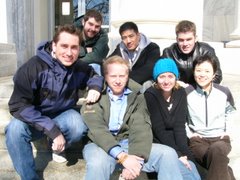
I’m Kathleen, conspicuously and deliberately absent from the group photo, and here is my story about finding work at AU.

When I first moved to Tenleytown (the D.C. district where AU is located), about a month before the Fall 2006 semester began, I needed a job—immediately! I had spent a lot of my savings to cover the security deposit and first month’s rent of my newly rented room in a house that was walking distance from AU (and the convenience of that was reflected in the price of the room), so I had to replenish my bank account for groceries and fun times at Adams Morgan (the Vegas strip of D.C., the party scene). I knew I wanted a job on campus so that I could easily move between my job, my classes, and extracurricular activities, without losing hours and hours commuting around D.C. (hey, and anyone who says you don’t need a car in D.C. because public transportation is “so good,” is either lying to you or has never had the luxury of owning a car—you DO need one!).

Before my move, I had checked out AU’s own webpage for on-campus jobs, http://www.american.edu/hr/pt_staff_main_frm.html, and had sent out my resume and cover letters to the personnel directors of several positions. Two days after my move, I already had two interviews lined up, and I was hired during the first one to work as a Fitness Leader at the gym. It was quick, simple, and convenient. I got started right away, and I even had early access to the gym (which otherwise was not available to new AU students until the start of the semester).

I worked at the gym for two months, and then another on-campus employment opportunity was thrown my way by a friend and classmate of mine. He worked part-time (20 hrs/wk) at the SIS Graduate Admissions Office, and they were hiring. The job he told me about, a work-study office assistant, paid nearly twice as much as my position at the gym, and it didn’t require me to work on weekends or start at 5am like the gym did; it was great! I applied, got an interview, and started a few weeks later. Since it was another job on campus, I didn’t even have to fill out any new paperwork for taxes and direct-deposit when I changed over, and my direct-deposit wasn’t interrupted at all—it was seamless.

It is very easy to find a job on campus at American University, and I highly recommend opting for a work-study position (if you’re eligible for one, which depends on your FAFSA results). Being able to choose your own hours helps a LOT with managing a full-time load of graduate classes, and the pay is plenty enough to support a comfortable student lifestyle (eating out a few times a week, and partying on the weekends). AU makes it a little less difficult to be a grad student, and for those who have yet to discover how “challenging” (to phrase it gently!) grad school is, let me tell you that this means a LOT! ;p

Thursday, March 1, 2007

Full Time vs. Part Time

Hey all,

Let me introduce myself, my name’s Adam Graham. You won’t find me on the picture of our fabulous cast (I’ll try to put up one later), but I’m well entrenched in the SIS admissions world. I’ve been working as an Admissions Counselor for SIS Graduate Admissions for the past two years and have come to call our now famous office home (I’ve even slept on our couch – we work hard!). I’ve also been attending a Master’s program at AU part-time since 2005.

When I first decided to apply to grad school I planned on attending full-time and scrounging for scraps as I relived a little bit of my undergraduate years - going to school during the day and working a couple of hours at night to make ends meet. I was confident I had a great GPA and pretty decent GRE scores and thought Grad schools would be lining up to throw a little bit of money my way.

Imagine my surprise when I found out that I didn’t receive any merit aid from any of the schools I was accepted into. I knew my parents couldn’t help me out at all if I decided to go and I saw no other way to pay for Grad school. I was pretty depressed.

Then someone suggested I go part-time (this sounds a lot like a drug commercial right about now). I hadn’t really thought about going part-time because I was very much into the idea of getting back into college life and I wanted to be able to finish my program in 2 years. But as I thought more about it, it seemed to make a lot of sense.

I’m now working at American full-time and doing my master’s part time. I’ve managed to live comfortably while completing my degree, am coming out of my program with little debt and I’m finishing in 2 years!

So I wanted to give you all some of the positives and negatives to enrolling part-time and full-time.


Positives for Full-time:

-If you receive merit aid I really think it’s a no-brainer – there’s nothing better than receiving free education.

-A much lower level of stress. Full-time is 3 classes, part-time is 2 – you do the math. Working full-time and taking 2 classes is harder than taking 3 classes and working occasionally.

-A social life. Part of grad school is hanging out with the other brilliant minds that have decided to come to AU - sometimes this is talking about books and your research, sometimes this is having a beer together. If you’re a part time student working full-time there’s less chance to engage in frolicking with your cohort.

-Research. If you’re a part time student working full-time you severely limit the number of academic conferences and lectures you can go to and have little time to work on getting published. If you are committed to doing this get ready to burn the midnight oil almost every night


Positives for Part-time:


-Better Living Conditions – If you have a job to support yourself while going to grad school you won’t need to eat Ramen noodles for 24 months and you’ll be able to afford to take a girl on a date. Ripping flowers out of someone’s garden followed by a dinner from the dollar menu at Micky Dee’s does little for your suave.

-Less Debt – If you’re planning on taking out some loans to finance living expenses while taking out loans to pay for education you can find yourself in a lot of debt at the end of two years. It’s definitely worth it if this is what you want to do (banks often consider education loans as Positive credit on your credit score because it makes you more marketable) and many students at SIS do this (you can ask Gabe or Jeremy), but it’s pretty nice to know that I’ll be able to pay off my debt in one or two years after I finish my degree.

-Working at the University? – If you end up getting a job at American, the university offers tuition remission for full-time employees. Not only do I love my job, I get a nearly free degree out of it too.

-Career Experience – If you are working while going to school you’re earning both work experience and academic credentials. Your resume is that much more marketable.

Anyway, that’s the end of the blog. If you guys end up having any questions after reading this and want to chat you can always send me an email at agraham@american.edu. Hope this has helped.

Peace,

Adam