SIS AUDIO LIBRARY

The SIS Audio Library allows you to hear recent speakers and professors, providing insight into current and relevant political and social issues of our time. Their expert instruction and a variety of guest speakers are just a click away at: http://www.american.edu/sis/pouch/sisaudio.html

Tuesday, March 11, 2008

Thesis or SRP?

As an SIS graduate student, you have lots of academic choices. Choosing whether to write a master’s thesis or another type of capstone work is one of them. Many people thinking about grad school wonder, “Do I have to come knowing what I’m going to write my thesis on?” The answer at SIS is no—but if you have an idea, great, if not you’ll find it while you here!

I’m not an academic guidance counselor, but I made the choice between an Significant Research Project (SRP) and thesis, as everyone else at SIS does. This blog is what I feel might be useful for those of you choosing a grad program or stressing about thesis.

The Technical Note: For the vast majority of SIS master’s programs you may complete either: 1. a substantial research paper (SRP) for 3 credits and a 3-credit internship, 2. a 6-credit thesis, or 3. a 6-credit research practicum. People choose SIS for graduate school for many reasons, and the research and writing requirement allows you to accomplish your own goals. In my last semester, I am taking a 3 credit internship and writing an SRP.

Roughly, the master’s thesis involves an 80-100-page paper representing an original contribution to the literature existing on your topic, the coursework is spread out over two (or more) semesters and accompanied by an oral defense at the end.

The Personal Note: I chose the International Communication program due the professional nature of the program, and writing an SRP and taking an internship for credit met my professional goals. I used the internship requirement (work in a field related to your academic coursework) to take time during this semester to explore a career I am interested in after graduation—I’m currently a government and public affairs intern at MWW and writing my SRP on the corporate sector’s contribution to public diplomacy in Eastern Europe.

If you’re really good, you might also be able to directly connect your internship and SRP. For instance, if you are working for an NGO and your job is to track and report on the recent democratic uprising in Burma, you can integrate the two for your SRP.

I had a good idea of what I was interested in when I started at SIS, however, I had no clue as to what topic I wanted to devote myself to researching for my SRP until recently. Professors, especially in the International Communication program, encourage you to find your knowledge niche—an area/topic that you can explore in your class research projects and papers and develop as your base of expertise. The majority of paper topics are open, and you can test out your depth of interest in an area in many courses before you decide what it is that you’re passionate about before you commit to developing around 70 pages on it. And the SIS graduate academic advisors are always available to help you figure things out.

Bottom line is you don’t need to stress about what you’re going to write about, you just need to be motivated to explore.

Happy Academic Travels,

Kate

Master’s Candidate 2008

International Communication

Knowledge Niche: Public Communication & Eastern Europe

Wednesday, March 5, 2008

DC internships

This post was written by Kate Bartosik, a second-year MA candidate in International Communication.

Internships in D.C., I have had a few. Private sector, public sector, corporate, non-profit, paid, unpaid, for credit, not for credit… DC offers it all, and as a graduate student at SIS, internships give you the ability to test out professional life.

I finish my graduate degree in international communication (IC) this May. Right now, I am an intern at MWW Group, a government and public relations firm. It’s my third internship in DC and this one I am taking for credit to meet a requirement of the IC program (you can complete a master’s thesis or write a major research paper and do an internship for credit—SIS offers good program flexibility).

How do SIS students get internships? Methods vary, but I use resources like the SIS networking events, the AU CareerWeb (AU’s Career Center’s online job and internship database), SIS listserv messages (alumni and professors post job/internship openings and the career center sends out a weekly list) and my own contacts. These resources are tailored for SIS students, making your search for a relevant internship experience much easier.

The Career Center offers quick drop-ins in the SIS coffee house, which I used when I first began applying for internships. A quick edit from Olya Dadressan, an SIS career advisor, and my resume was markedly better. I was able to secure my current internship and one last semester at Mazda’s Government and Public Affairs Department by applying online through AUCareerWeb.

The Career Center and the SIS Graduate Student Council (GSC) also host networking events on campus throughout the year, giving current students the chance to interact with alumni, professors and career center advisors. These provide opportunities to find out about internships and get advice from professionals.

I was able to get a job for last summer through the GSC’s spring speed-networking event. I had not planned on attending the event, but my class got out early, so I went. I had been at work earlier that day, so I was dressed professionally and had a few business cards on me (I’ll admit I design/print my own on my computer). I went with the expectation that I might learn more about possible career paths and maybe make a contact. My initial contact with an AU alumnus at the event turned into a communication job at the National Association of Realtors. Networking opportunities are everywhere, being aware and making the time is the key!

This time around, I had the most success using the AU CareerWeb. After submitting applications (standard cover letter, resume and writing sample) to about seven companies, I was offered four interviews, three at public relations firms and one at an NGO, the Council for a Community of Democracies. I did prep for the interviews: read the organization’s websites, spoke to someone I knew who had interned there before and checked other publications that had covered the organization. Contacting the career center to see if they have any alumni contacts with the company to which you are applying is also useful. I sent thank you letters to those I interviewed with and at the end I had a few offers on the table. I choose MWW, because the job content fit closest to my career interests.

If you are just moving to DC, sans job, registering at a temp agency, like The Choice, Inc., is a good place to make some cash while job/internship hunting. Graduate school is about the last time you’ll be able to “test-drive” a career through an internship. You’re in DC—internships help you build your resume even if you’re not taking them for credit! It’s a very real possibility to find a part-time job or paid internship anytime of the year in DC, and balance with a full class load at SIS.

Important Note: The views expressed are my own and in do not necessarily represent the opinions, positions or strategies of MWW Group nor any other mentioned organization.

Tuesday, December 18, 2007

Active on the AU Campus and in Washington D.C.

Hey everyone,

My name is Leslie and I'm a second-year grad student at SIS, focusing my International Politics degree on Human Rights and Global Environmental Policy. Many of you probably saw all the news coverage about the protests in Burma earlier this fall. But what you likely didn't see was all the activist work that goes on behind the scenes here in DC. I've been fortunate enough to become involved in the Free Burma movement at AU, and I'd like to share some of that with you.
Like most activist causes, the Free Burma movement relies on a core group of focused, motivated, and dedicated individuals. From the annual student-led Alternative Break trips to the Thai-Burma border learning about the social justice aspects of Burma, to the Student Campaign for Burma here on campus that is composed of both graduate and undergraduate students, AU students have continually been at the forefront of campus and community Burma activism.
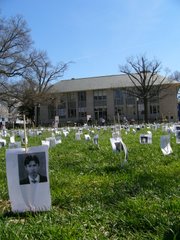
On campus, we "flagged the quad" to represent the 100,000 protesters in Rangoon and create a visual representation for the AU community (see more pictures on our blog). On the Hill, we filled a Senate hearing on the Saffron Revolution wearing tee shirts that proclaimed "UNSC Arms Embargo Now," and have alerted our campus community, friends and family to pass an important bill to shut down funding for the military regime. We helped to organize several protests at the Burmese, Chinese, and Indian Embassies which attracted several hundred individuals from DC and a good deal of media attention. We launched petition signing campaigns, film screening, speaker panels, and fundraisers for Burmese aid organizations. There are so many different ways to become involved, and I've had the chance to experience so many of them through my connections at American University and by being in Washington, D.C.

For more information on Burma activism at AU, please visit our blog at http://auburma.blogspot.com/, or email us at auburma@gmail.com .

Monday, December 10, 2007

Opportunities for Sudents to Publish

Dear all,

Today’s topic is our student-run journal, Swords and Ploughshares. The journal is an academic publication in the style of such periodicals as International Security and the Journal of Foreign Affairs. The articles are all written by students at SIS and Washington College of Law, and are typically refined pieces that were written for a class or for a research requirement. There is no central topic focus, other than the obvious international affairs theme. Anything within international affairs will be considered for publication. In recent issues we have published articles on various topics including international whaling laws and regulations; a comprehensive definition of terrorism; and the security of Russia’s energy sector.

I’m going to discuss two aspects of the journal as it relates to you, the grad student. First, Swords and Ploughshares presents you with a great opportunity for getting involved with something on campus. In the interest of full disclosure, I currently serve on S&P’s Editorial Board and as the Senior Copy Editor. It is not a paid job (wouldn’t that be nice…), but it can give you valuable experience in the publishing process that will serve you well on your résumé, especially if you are considering employment at a research foundation (a think-tank). Unless you are one of the senior editorial staff, the time commitment is relatively minimal.

Secondly, the journal is obviously a great opportunity to get your work published. We send out calls for papers at the beginning of every semester through the SIS listserv (I encourage you to subscribe to it) and also through “The Diplomatic Pouch”, our SIS newsletter. Submit something whenever you have a piece of work of which you are particular proud. The work you send us should be your very best. Don’t send us a rough draft or a paper you wrote overnight. Although we have editors, we want articles that exhibit a polished and professional writing ability. We have received articles in the past that contained potentially interesting subject matter, but were so poorly written that we had to decline them. The best way to ensure the professional caliber of your work is to involve a professor in the process. They can give you valuable insight into a research strategy, as well as helpful critique of your writing style and technique (remember, professors do this for a living). Don’t let your ego get in the way of improving your writing skills. Always have someone read and critique your work before you submit it for publication, and take their remarks seriously and objectively. Again, professors are the best source for this type of help. You won’t have to share authorship credit with them. All you have to do is thank them for their guidance in a footnote on the first page. Finally, it always helps to read the reputable journals in the field, such as the aforementioned. You’ll get a feel for what kind of style is appropriate for publication as well as how to structure a good argument. All this equates to better papers and, yes you guessed it, better grades in your classes!

So there you have it. Get involved and constantly seek to improve your skills as writer. I’m looking forward to seeing your submissions for future issues of Swords and Ploughshares.

Yrs. Truly,
Andy

“As in political so in literary action, a man wins friends for himself mostly by the passion of his prejudices and the narrowness of his outlook.” – Joseph Conrad

Monday, December 3, 2007

First Semester as an International Student


Today's SIS blog written by Gayatri Murthy, MA International Communications Candidate 2009


As I begin my final week of my first semester here at AU’s School of International Service, it is easy for me to see that choosing to study International Communications at SIS was one of the best decisions of my life. As an international student, having lived my whole life in one place and never dared to move out of my comfort zone, I was eager to venture into new horizons, explore the world around me and challenge myself to the greatest extreme. And the School of International Service was all that and more.

My experience so far has been overwhelming. I feel as if I have been using only a small portion of my brain and every day in the International Communication program is a challenge. I can almost feel little neurons in my brain waking up to this vast pool of knowledge every minute. My classes make me think in directions I have never thought before. I felt a similar surge of emotions in my freshman year of college in India, when I was grappling with new concepts and ideas for the first time. At that time, I thought it was the spirit of being in college and just a passing idealist phase. But now I truly believe that ideas truly drive the world as we know it. As Churchill says, “"the empires of the future are the empires of the mind”, and I know this is the most ideal breeding ground for the best the world has to offer. Besides being this melting pot of divergent, yet interesting intellectual viewpoints, the most special quality at SIS is its sense of community. It is a forum for all voices, and the spirit of SIS encourages all these voices to co-exist and indeed, enhance one’s own intellectual growth. In my classes, or even in the Davenport, I have never encountered a brutal sense of competition, so typical of most professional schools. My transition as an international student couldn’t have been easier. I have met some of the most dynamic and diverse people here, whom I am proud to call my friends and I could not be happier to be right here at this point in my life.

On the flipside there are several underlying, yet complex themes to life as an international student. Since I came from an upper middle class, urban and English speaking background, I was lucky enough to not experience a great deal of culture shock or language barriers. But being far away from home, from one’s comfort zone makes you question your identity, your sense of belonging, the contribution of culture to your sense of being and myriad other questions which generally don’t have easy answers. As I count the days to Christmas break when I go back home (Bombay, India), I am once again filled with bittersweet feelings. I can not wait to go back home and yet a part of me feels at home in DC as well. Sometimes when you’re a foreign student, you run the danger of being out of context in all your contexts. As a student here, I constantly deal with explaining the origins of my points of views, and sometimes when I talk to friends and family back home; it becomes hard to contextualize all of my new experiences easily, in a way that they both truly understand me.

There are no solutions to this unique dichotomy and longing. But Grad school, for everyone alike, can be a quest to find one’s identity and it need not be a tiresome task. Instead, it can (and quite frankly is) the journey of a lifetime. You can’t hurry self discovery and a little patience makes the ride a lot more meaningful than the destination itself.

Monday, November 26, 2007

Special Opportunities at SIS – The Peacebuilding & Development Institute (PDI)

This post was written by Sarah Sladen, an MA candidate in the Peace and Conflict Resolution field.

If you are considering an internship while at SIS, particularly in your first semester, the Peacebuilding & Development Institute (PDI) is a great way to complement your studies while networking with practitioners and organizations from throughout Washington, DC. PDI provides cutting-edge special research, training, and capacity-building opportunities for practitioners and scholars in areas of development, humanitarian assistance, diplomacy, and conflict resolution. The Institute has several components: Training & Symposia, the Summer Institute, the Children and Youth Division, the Peacebuilding Forums, and International Programs. These components integrate policy, practice, and theory to create new approaches to conflict-sensitive and transformative peace practice.

One of PDI’s largest programs is its annual Summer Institute. The Summer Professional Training Program offers trainings to foreign aid workers, government officials, conflict resolution practitioners, Master’s students, and others working in conflict zones to complement their daily field work. Interns with PDI provide vital support for the program’s planning and implementation, participate in courses, and meet participants and trainers drawn from throughout Washington, DC and abroad.

My position as PDI’s Research Associate for Youth & Conflict has been a great way to gain experience in qualitative research methods, as well as some insight into the various components involved with undertaking a major research project (good preparation for the thesis or Substantive Research Project (SRP) all Master’s students choose between in their second year). I’ve also been able to participate in training workshops such as Conflict Sensitive Program Design, and assist with the coordination of an upcoming panel at AU on youth, education, and conflict. The internship has allowed me to engage with my specific interests early on in the program and work closely with faculty from the International Peace and Conflict Resolution department. As someone new to Washington, DC, it has also been an excellent way to get familiar with the numerous organizations and their staff that focus on youth and conflict issues. Although the institute has numerous ongoing projects, PDI is also open to new ideas; if there is a particular workshop or event you would like to see at SIS, PDI can help make it happen.

An internship in your first semester can be a lot to take on in addition to adjusting to classes, life in a new city, and especially if, like most Master’s students, you also plan to work part-time. The advantage of doing an internship on campus with a center like PDI is that its staff is well-aware of the multiple commitments that students have to balance. The internship is flexible, allowing students to commit as much time as they are able and to choose from numerous semester or year-long projects. You can learn more about PDI at http://www.american.edu/sis/peacebuilding/2008.htm.

Friday, November 16, 2007

Internships - Center for Strategic & International Studies

Hey, it’s Josh. I’m writing today to talk about an internship I recently started with the South Asia program at the Center for Strategic and International Studies (http://www.csis.org/).

Students at SIS have the option of working at an internship for course credit. To fulfill the program’s research requirement you can either write two substantial research papers (about 50 pages each), write a thesis (about 100 pages) or write one 50-pager and one semester-long internship. Wanting to mix academics with real work experience in D.C. is usually the popular choice for obvious reasons.

An internship here can be really interesting if you pick the right one. As part of my responsibilities at CSIS, I’m helping my boss with research for her upcoming book on U.S.-India relations, I will be writing an edition of our monthly publication “The Monitor” and I've had a hand in planning a number of our major events. Almost everyday there is a new and interesting conference taking place somewhere in our large building. I won’t lie and say it’s all the most exciting work, but graduate internships are by no means glorified donut-getters and coffee cup filler-uppers either.

On top of fulfilling your requirement for the program, the internship is a great way to get a valuable letter of recommendation in a competitive town such as Washington, D.C. In fact, sometimes the internship even leads to actual employment when your time is through. I plan on using the experience I gain at CSIS to help make this transition as I finish my degree.

Josh